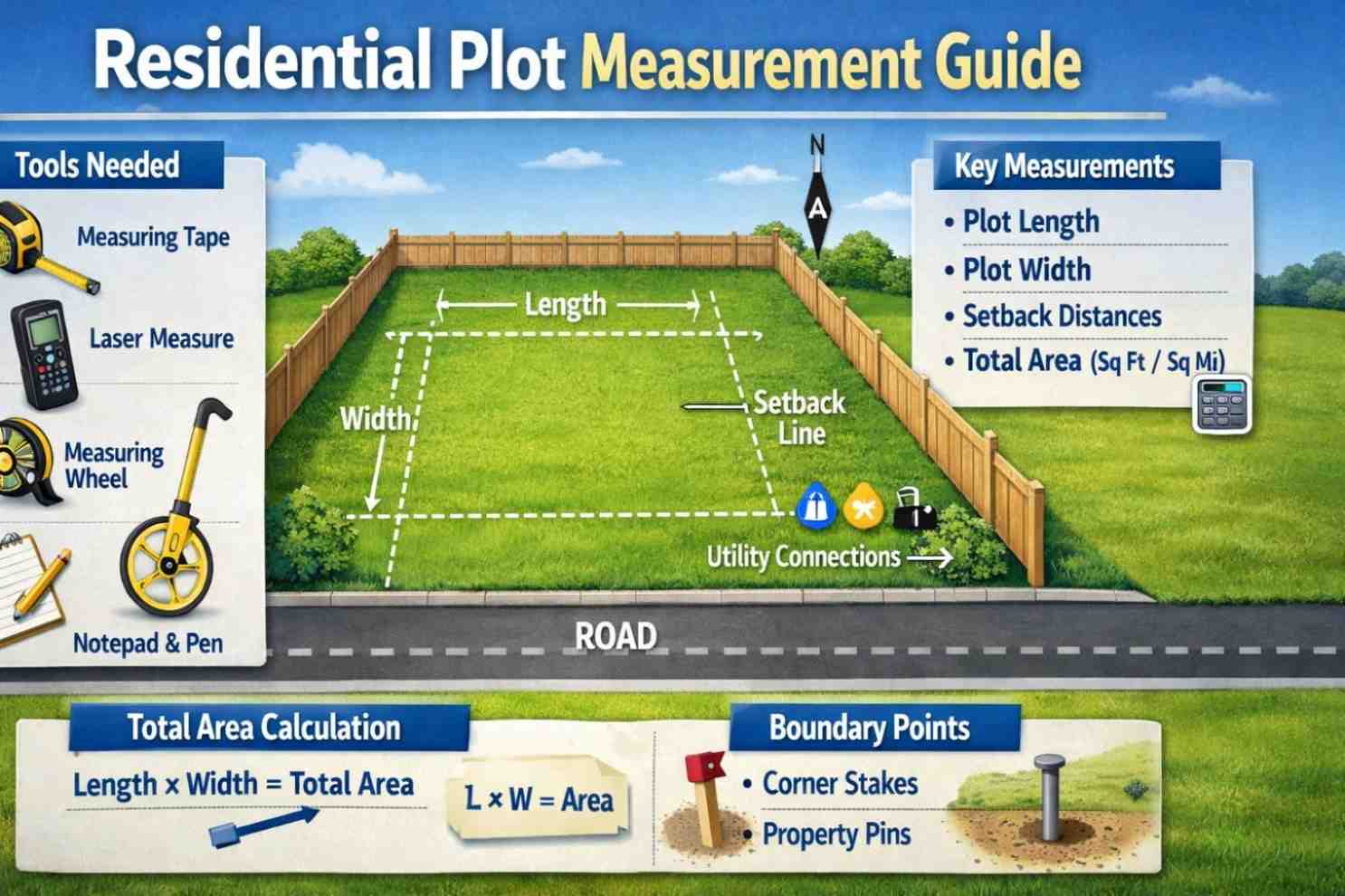
Measuring a residential plot correctly is one of the most important steps before buying land, building a house or selling property. Many people make mistakes in plot size calculation because they do not understand land measurement formulas or conversion methods. Whether you are buying a house plot, planning construction or checking property documents, knowing how to measure a residential plot accurately is essential.
This residential plot measurement guide explains how to calculate plot area step by step using simple formulas. You will learn how to measure plot dimensions, convert land units and use a free plot area calculator to calculate residential land area accurately. This guide is useful for property buyers, real estate agents, engineers and homeowners.
Featured Snippet: Key Plot Measurement Formulas
Basic plot area calculation formula:
- Area = Length × Width (for rectangular plots)
- 1 Acre = 43,560 square feet
- 1 Cent = 435.6 square feet
- 1 Square Meter = 10.764 square feet
- 1 Decimal = 435.6 square feet (same as Cent)
Example Calculation:
Plot dimensions: 40 ft × 50 ft
Area = 40 × 50 = 2,000 sq ft
Convert to acres: 2,000 ÷ 43,560 = 0.0459 acres
Use our free plot area calculator for instant and accurate calculations.
Why Residential Plot Measurement Matters
Accurate plot measurement is crucial for various property-related activities and financial decisions. Incorrect measurement can lead to legal disputes, financial losses, and construction problems.
Buying & Selling Property
Accurate measurement ensures fair pricing and prevents disputes in property transactions. Buyers get what they pay for, and sellers can price their property correctly.
House Construction Planning
Proper plot measurement is essential for designing house plans, calculating building materials, and complying with local building regulations and FSI/FAR calculations.
Legal & Registration Purposes
Property registration, mutation, and legal documentation require accurate plot measurements. Incorrect measurements can lead to legal disputes and registration delays.
Loan Approval & Valuation
Banks and financial institutions require accurate plot measurements for property valuation, loan approval, and mortgage documentation.
Property Tax Calculation
Municipalities calculate property taxes based on plot area. Accurate measurement ensures correct tax assessment and prevents overpayment or penalties.
Boundary Identification
Precise measurement helps identify exact plot boundaries, preventing encroachment issues and disputes with neighbors.
Common Plot Measurement Units
Understanding the most common residential plot measurement units is essential for accurate calculation and conversion across different regions and countries.
Square Feet (sq ft)
Most common unit for residential plots worldwide. Used for property documents, construction planning, and real estate transactions. 1 sq ft = area of a square with 1-foot sides.
Acre
Standard imperial unit for larger residential plots. Commonly used for villa plots, farmhouses, and large residential properties. 1 acre = 4,840 square yards.
Cent
Traditional unit widely used in South Indian states for residential plots. 100 cents equal 1 acre. Commonly used in Tamil Nadu, Kerala, Karnataka, and Andhra Pradesh.
Square Meter (sq m)
Standard metric unit for residential plots. Used in official documents, building plans, and international property standards. 1 sq m = area of a square with 1-meter sides.
Decimal
Common unit in Eastern Indian states for residential plots. Same value as Cent (1 decimal = 1 cent). Used in West Bengal, Odisha, Bihar, and Assam.
Square Yard
Traditional unit still used in some regions for residential plots. Commonly used in North India and Pakistan. 1 square yard = 3 feet × 3 feet.
Basic Plot Area Formula
The simplest formula to calculate plot area for rectangular or square plots is:
Formula for Rectangular Plots
This formula works for any rectangular or square plot. For accurate results, measure in the same unit (feet or meters) and ensure measurements are taken at right angles.
Formula for Square Plots
For square plots, all sides are equal, so you only need to measure one side. Square the measurement to get the area.
Practical Application
Always double-check measurements and use our plot area calculator for verification and unit conversion.
How to Measure Residential Plot (Step-by-Step)
Follow these detailed steps to measure your residential plot accurately, whether you're using traditional tools or modern technology.
Step 1: Gather Tools
Select appropriate measurement tools: measuring tape (50-100 ft), laser distance meter, GPS device, or smartphone with measurement app. Ensure tools are calibrated and in good condition.
Step 2: Identify Plot Shape
Determine if your plot is regular (rectangle, square) or irregular. For irregular shapes, you'll need to divide into regular sections or use specialized measurement methods.
Step 3: Measure Length
Measure the longest side of the plot (length) in feet or meters. Take multiple measurements at different points and use the average for accuracy, especially if boundaries aren't straight.
Step 4: Measure Width
Measure the side perpendicular to the length (width). Ensure measurements are taken at right angles for accurate area calculation. Use a builder's square or the 3-4-5 triangle method to check right angles.
Step 5: Calculate Area
Multiply length by width to get area in square feet or square meters. For rectangular plots: Area = Length × Width.
Step 6: Convert Units
Convert the calculated area to your preferred unit (acres, cents, square meters) using conversion factors or our calculator tool.
Plot Area Calculation Examples
Let's walk through practical examples to understand residential plot measurement and conversion better:
Example 1: Standard Residential Plot
Scenario: A rectangular plot measures 50 feet by 80 feet. Calculate area in different units.
Typical use: Standard plot size for a 3-4 bedroom house in urban areas.
Example 2: Apartment Plot Calculation
Scenario: A housing society plot measures 200 feet by 300 feet. Calculate total area and individual plot sizes if divided into 20 equal plots.
Typical use: Housing society or apartment complex planning.
Example 3: Unit Conversion Practice
Scenario: A plot is advertised as 5 cents. Calculate equivalent area in square feet, square meters, and acres.
Typical use: Property comparison and verification of advertised plot sizes.
Measuring Irregular Plots
Many residential plots have irregular shapes, but you can still measure them accurately using these techniques:
Method 1: Divide into Regular Shapes
Divide irregular plot into multiple regular shapes (rectangles, triangles), measure each section separately, then add all areas together.
Method 2: Triangle Method
For plots with multiple sides, divide into triangles and use Heron's formula or basic triangle area formula.
Method 3: Technology Solutions
Use GPS devices, smartphone apps, or online mapping tools to trace irregular plot boundaries for automatic area calculation.
Residential Plot Conversion Chart
Use this comprehensive conversion chart for quick reference when converting between common residential plot measurement units:
| Unit | Square Feet | Square Meters | Acres | Common Usage |
|---|---|---|---|---|
| 1 Square Foot | 1 | 0.0929 | 0.000023 | Basic unit for all plots |
| 1 Acre | 43,560 | 4,047 | 1.000 | Large residential plots |
| 1 Cent | 435.6 | 40.47 | 0.010 | South Indian residential plots |
| 1 Decimal | 435.6 | 40.47 | 0.010 | East Indian residential plots |
| 1 Square Meter | 10.764 | 1 | 0.000247 | International standard |
| 1 Square Yard | 9 | 0.836 | 0.000207 | North Indian residential plots |
| 1 Ground | 2,400 | 223 | 0.055 | Tamil Nadu residential plots |
| 1 Bigha (approx) | 27,000 | 2,509 | 0.620 | North Indian large plots |
Plot Measurement for House Construction
Accurate plot measurement is critical for successful house construction planning and execution:
Building Plan Design
Accurate plot measurements are essential for designing house plans that comply with local building regulations, setback requirements, and FSI/FAR calculations.
Material Calculation
Calculate construction materials (cement, bricks, steel) based on accurate plot measurements and building design specifications.
Site Planning & Layout
Plan site layout including building position, driveway, garden, septic tank, and utility areas based on exact plot dimensions.
Cost Estimation
Estimate construction costs accurately based on plot size, built-up area, and local construction rates per square foot.
Regulatory Compliance
Ensure compliance with local building codes, minimum plot size requirements, and zoning regulations based on accurate plot measurements.
Contractor Documentation
Provide accurate plot measurements to contractors for quotations, agreements, and construction planning to avoid disputes and cost overruns.
Common Plot Measurement Mistakes to Avoid
Avoid these common errors when measuring residential plots to ensure accuracy in property transactions and construction planning:
Measuring Only One Side
Problem: Assuming opposite sides are equal without measuring both sides, especially in irregular plots.
Solution: Always measure all four sides of the plot, even if it appears rectangular.
Wrong Unit Conversion
Problem: Using incorrect conversion factors, especially for traditional units like cents, decimals, or bighas.
Solution: Use verified conversion factors or our plot area calculator for accurate conversions.
Ignoring Irregular Shapes
Problem: Treating irregular plots as rectangular without proper division and calculation.
Solution: Divide irregular plots into regular shapes or use technology tools for accurate measurement.
Not Verifying Documents
Problem: Relying solely on physical measurement without checking property documents and survey maps.
Solution: Cross-verify physical measurements with official documents and survey maps.
Incorrect Angle Measurement
Problem: Not ensuring right angles when measuring length and width, leading to inaccurate area calculation.
Solution: Use the 3-4-5 triangle method or a builder's square to ensure right angles.
Using Worn Tools
Problem: Using stretched or damaged measuring tapes that give inaccurate readings.
Solution: Use calibrated measuring tools or digital measurement devices for better accuracy.
Plot Measurement for Property Buyers
When buying a residential plot, accurate measurement verification is essential to ensure you get what you pay for and avoid future disputes:
Verify Document Measurements
Compare the plot area mentioned in sale deeds, property papers, and survey maps with physical measurements. Look for unit consistency and conversions.
Physical Boundary Measurement
Measure all boundary sides physically or hire a licensed surveyor to verify plot dimensions, especially corner points and boundary markers.
Unit Conversion Verification
Convert all measurements to a standard unit (square feet or square meters) to compare properties and ensure consistency across documents.
Check for Encroachments
Verify that neighboring structures or boundaries don't encroach on the plot you're buying by measuring from established reference points.
Legal Compliance Check
Ensure plot measurements comply with local land division laws, minimum plot size regulations, and zoning requirements.
Use Measurement Calculator
Utilize our plot area calculator to verify seller's claims and perform quick conversions during property evaluation.
Tools Used to Measure Residential Plots
Various tools are available for measuring residential plots, ranging from traditional methods to modern technology:
Measuring Tape
Traditional tool for measuring small to medium plots. Choose steel or fiberglass tapes (50-100 ft) for durability and accuracy.
Laser Distance Meter
Modern electronic device that uses laser technology for precise distance measurement up to several hundred feet with millimeter accuracy.
Smartphone Apps
GPS and camera-based apps that can measure distances and calculate areas using smartphone technology. Convenient but less accurate than dedicated tools.
Plot Calculators
Online tools like our plot area calculator for quick conversions, area calculations, and irregular shape measurements.
Survey Maps
Official government survey documents showing exact plot boundaries and measurements for legal verification and planning purposes.
Builder's Square
Tool for ensuring right angles during measurement. Essential for accurate area calculation of rectangular plots.
Residential Plot Measurement in India
India uses diverse measurement systems for residential plots across different states and regions:
North India
Common Units: Square Feet, Square Yards, Square Meters, Bigha, Marla
States: Delhi, Punjab, Haryana, Uttar Pradesh, Rajasthan
Key Conversion: 1 Marla = 272.25 sq ft, 1 Bigha = 27,000 sq ft (approx)
South India
Common Units: Square Feet, Cents, Square Meters, Ground, Ankanam
States: Tamil Nadu, Karnataka, Kerala, Andhra Pradesh, Telangana
Key Conversion: 1 Cent = 435.6 sq ft, 1 Ground = 2,400 sq ft
East India
Common Units: Square Feet, Decimals, Square Meters, Katha, Bigha
States: West Bengal, Bihar, Odisha, Assam, Jharkhand
Key Conversion: 1 Decimal = 435.6 sq ft, 1 Katha = 720 sq ft (WB)
West India
Common Units: Square Feet, Square Meters, Guntha, Vigha
States: Maharashtra, Gujarat, Goa, Rajasthan
Key Conversion: 1 Guntha = 1,089 sq ft, 1 Vigha = 17,424 sq ft
Frequently Asked Questions
To calculate plot area accurately: 1) Measure all sides of the plot, 2) For rectangular plots, use Area = Length × Width, 3) For irregular plots, divide into regular shapes and calculate each area, 4) Add all areas for total, 5) Convert to desired units using verified conversion factors, and 6) Verify with property documents. Use our plot area calculator for automatic calculations and verification.
1 acre equals 43,560 square feet. This is the standard conversion used worldwide for land measurement. To visualize, 1 acre is approximately 90% of a standard football field or about 208.71 feet by 208.71 feet if it were a perfect square. This measurement is crucial when buying large residential plots or comparing property sizes.
To measure irregular plots: 1) Divide the plot into regular shapes (rectangles, triangles), 2) Measure each section separately, 3) Calculate area of each section using appropriate formulas, 4) Add all areas together for total plot area, 5) Alternatively, use GPS devices or smartphone apps that can trace irregular boundaries. For complex shapes, consider hiring a professional surveyor or using our irregular plot calculator.
Square feet is the most common unit for residential plots worldwide. In India, square feet is widely used alongside traditional units like cents (South India), decimals (East India), and square yards (North India). For official documents and construction planning, square meters is also commonly used. Always confirm the local unit when buying property and use our conversion chart for accurate conversions.
For most residential plots, a 100-foot measuring tape provides sufficient accuracy. For better precision, use a laser distance meter. For irregular or large plots, GPS devices or smartphone measurement apps are convenient. For legal documentation, always refer to official survey maps. Our plot area calculator is essential for converting between units and verifying calculations regardless of the measurement tool used.
Conclusion: Residential Plot Measurement Guide
Accurate residential plot measurement is essential for buying property, building a house and calculating land value. By understanding plot area formulas and using a reliable plot area calculator, you can measure plot size accurately and avoid costly mistakes. This guide helps you calculate plot area step by step and convert land units easily.
Key takeaways from this residential plot measurement guide:
- Always use accurate tools and verified conversion factors for plot measurement
- For rectangular plots, use the basic formula: Area = Length × Width
- For irregular plots, divide into regular shapes and calculate each area separately
- Convert all measurements to standard units (square feet/square meters) for comparison
- Verify physical measurements with official property documents and survey maps
- Use modern technology (laser meters, GPS apps) for better accuracy on large or irregular plots
- Always double-check calculations, especially for property transactions and construction planning
This comprehensive guide provides formulas, charts and examples so you can measure residential plots easily and avoid costly mistakes. Bookmark this page and use our free plot area calculator whenever you need to measure or convert plot area for your property transactions or construction projects.
SEO Description
Learn how to measure residential plot size using simple formulas and calculators. Complete residential plot measurement guide with examples, conversion charts and free plot area calculator. Essential for property buyers, homeowners, and real estate professionals dealing with plot measurement and conversion.